Case study
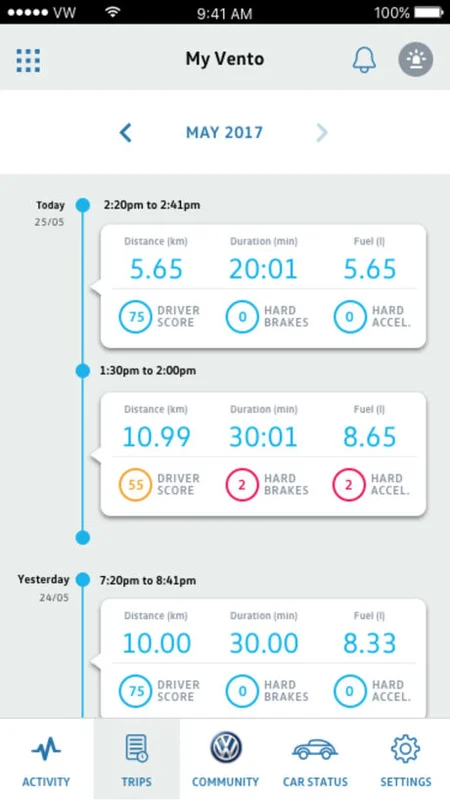
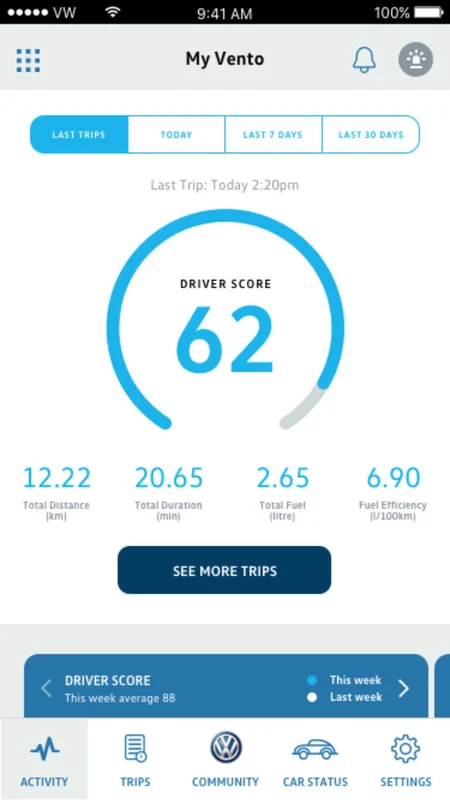
Volkswagen wanted drivers to get more out of the data their cars already produce. We built connected-car application capabilities that turn that data into trip history, driving metrics and maintenance scheduling a driver can actually use. Each trip showed a driving score, fuel consumption, distance and duration, refreshed in the background roughly every three minutes.
The challenge
A car generates a constant stream of telemetry, but a driver doesn't want telemetry. They want to know how far they drove, how efficiently, and when the car next needs attention. Trip data, driving history and maintenance information also arrive at different intervals, so the app had to present each one clearly and make it obvious how fresh it was.
What we built
We built the connected-car mobile experience around the driver rather than the vehicle's internals.
Trips a driver can read at a glance
Every trip came together as one summary. We grouped the numbers around the decisions a driver makes, such as easing off a heavy right foot or planning the next service, instead of exposing raw sensor readings.
A refresh rhythm built into the product
Because the app polled for new data on a short cycle, we designed the interface around that rhythm. Drivers could see when their trips and vehicle data were last updated and trust what was on screen.
Designed for patchy connectivity
Phones lose signal, apps get pushed to the background, and vehicle data arrives late. The experience showed the last sync time and kept missing data visibly separate from a normal reading, so a gap never looked like good news.
Maintenance next to the drive
Maintenance scheduling sat alongside trip history, so a driver checking last week's commute also saw what the car needed next.
How the workflow fits together
How a trip travels from the car to the driver's trip history.
Conceptual workflow
- Vehicle / connected service
- Telemetry API
- Connected-car backend
- Mobile app
- Driver insights
What we took from it
Connected-car apps earn trust by being honest about timing. A trip summary is only useful when the driver understands what was recorded and when it was last refreshed, and that principle shaped every screen we built for Volkswagen.
How we'd build this today
How we would build this today with Cortex
We built this app before Cortex existed. If Volkswagen asked us for the same experience now, here is what we would do differently.
- Replay real driving days in tests. We would build synthetic telemetry for commutes, tunnels, cold starts and long motorway runs, and run every screen against them before a driver ever sees it.
- Write down freshness rules first. For each number on screen, we would agree how old it can be before the app labels it as stale, and test that rule automatically.
- Let AI do the repetitive parts. Cortex can draft UI components, unit-conversion code and adapters for new vehicle data, while our engineers decide what each vehicle state means and how location history is protected.
- Check privacy on every change. Trip and location history would be tested against retention rules each time the app changes.
What the tests would check
- Stale telemetry is never shown as current
- Distance totals and unit conversions add up across every input
- Location and trip history follow privacy and retention rules
- The app recovers cleanly after a lost connection
Frequently asked questions
What did CognitiveClouds build for Volkswagen?
Connected-car app capabilities for trip history and maintenance scheduling, with driving-style metrics and periodic data refresh.
How did the app handle data that wasn't real time?
It refreshed in the background and showed drivers when data was last synced, so they always knew how current a reading was.
Was Cortex used on the original project?
No. The Volkswagen app predates Cortex; the section above describes how we would build it now.
Working on a connected product?
If you're turning vehicle or device data into something people check every day, talk to us. We'll start with how your data arrives, how late it can be, and what the person holding the phone needs to decide.
Related: Our work · How we deliver · About CognitiveClouds