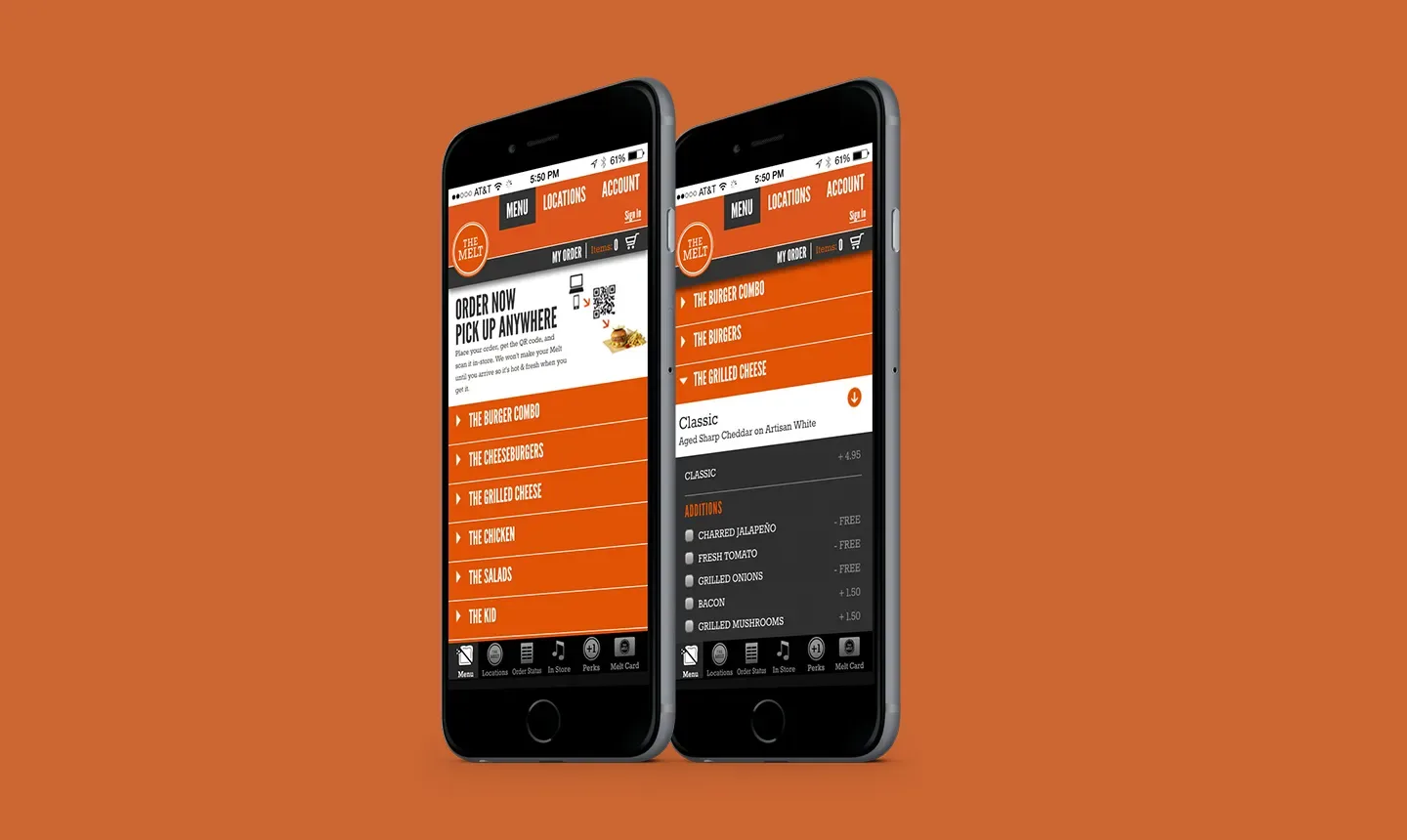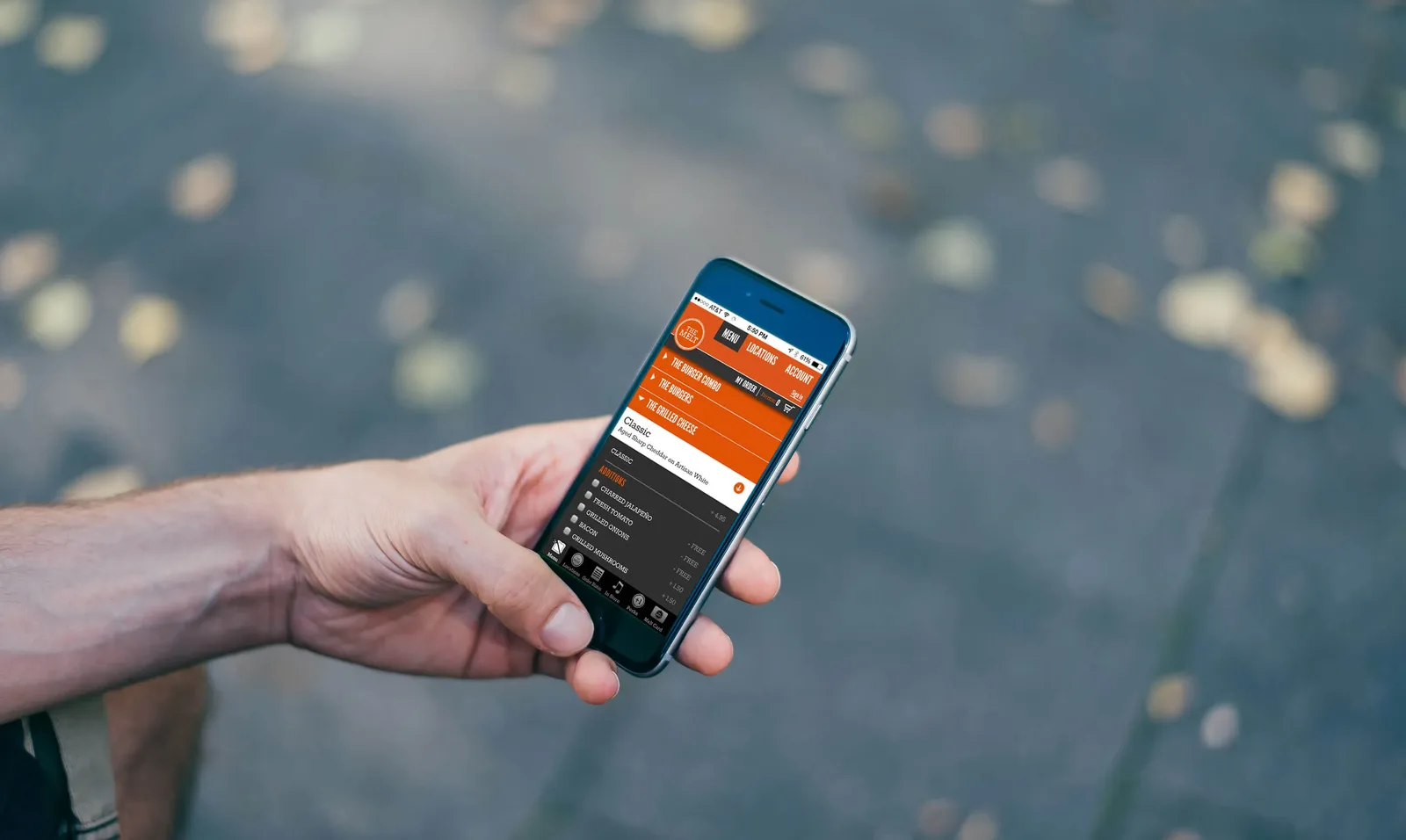

Case study
A customer sees a menu, customizes a burger, taps Order, and expects everything to work. Behind that ordinary-looking interaction is a chain of systems that cannot afford to disagree: the marketplace, the restaurant’s menu, pricing and modifiers, payment flows, the point of sale, the kitchen, and the customer-facing order status. One mismatch can turn a digital sale into a cancelled order or an operations problem.
That’s the engineering challenge we worked on with The Melt, the California fast-casual brand known for grilled melts, burgers and comfort food. CognitiveClouds helped modernize the digital foundation around The Melt’s guest ordering and restaurant operations—not simply its mobile screens. Our engagement spanned native iOS and Android experiences, backend services, integrations with DoorDash, Uber Eats and Grubhub, connectivity to POS and kitchen display systems (KDS), cloud infrastructure using AWS, and the internal tools needed to operate a growing restaurant business.
It was a restaurant commerce and systems-integration engagement. The mobile app was only the most visible part.
Engineering principle: A restaurant’s digital experience is only as good as the order that actually reaches the kitchen.
The real problem: restaurant ordering is a distributed system
From the guest’s perspective, restaurant ordering should be effortless. From the engineering perspective, a quick-service restaurant has several constantly moving sources of truth:
- A mobile app or website presents a menu and accepts first-party orders.
- DoorDash, Uber Eats and Grubhub maintain their own channel-specific order and menu models.
- Stores have different hours, service modes, prices, availability and preparation capacity.
- The POS must receive the right items, modifiers, tax and order instructions.
- The KDS has to present the correct ticket to the kitchen at the right time.
- Guests, drivers, store teams and headquarters all need an accurate view of order progress.
- Finance and operations need a way to understand what happened after the order was accepted.
These aren’t independent features. They are parts of one transaction lifecycle. A great app cannot compensate for a wrong menu item ID. A reliable webhook isn’t useful if it creates duplicate kitchen tickets. A successful POS injection is only half the story if cancellations or sold-out items remain unsynchronized.
The Melt’s earlier HTML5-first experience and fragmented processes created friction around performance, menu management, real-time kitchen visibility, operational controls and release processes. The goal was to create a more coherent architecture: better guest experiences built on dependable restaurant operations.
Our role: product engineering across the full ordering journey
CognitiveClouds took responsibility across multiple layers of the solution:
- Guest experience: native iOS and Android ordering, product customization, checkout, reorder and order status.
- Restaurant commerce backend: catalog, pricing, promotions, cart, ordering, store configuration and guest state.
- Marketplace integrations: integration work spanning DoorDash, Uber Eats and Grubhub.
- Restaurant execution: integration between digital orders, POS systems and kitchen workflows.
- Store and HQ tools: centralized menu management and operational controls for restaurant teams.
- Cloud and delivery engineering: AWS infrastructure work, deployment automation, environments, monitoring and ongoing engineering improvements.
This is why the engagement belongs in the category of QSR platform engineering, not merely restaurant mobile app development.
1. First-party ordering: native apps backed by restaurant-grade services
A restaurant app must combine a consumer-grade interface with uncompromising transaction correctness.
For The Melt, our mobile engineering work included native iOS and Android ordering experiences with menu browsing, modifiers, combos, favorites and reorder journeys, store selection, pickup and scheduled ordering, digital payments, promotional experiences and order updates.
The hard part is the contract between the device and the restaurant. Consider a guest adding a burger with a cheese substitution, a side upgrade and a special instruction. The experience is correct only if the order survives every translation intact—from the interface to the backend to the POS and finally to the kitchen.
We approached the digital ordering experience as part of a larger service ecosystem rather than an isolated mobile product. The backend needed to support channel-specific interactions while preserving consistent business rules.
2. DoorDash, Uber Eats and Grubhub: one restaurant, multiple marketplace contracts
For a QSR, third-party delivery is not just an additional sales channel. Each marketplace has its own APIs, order structures, modifier representation, timing rules, store identities, cancellation behavior, operational events and integration constraints.
Our work with The Melt included integrations with DoorDash, Uber Eats and Grubhub. The central engineering concern was maintaining a dependable connection between external ordering systems and the restaurant’s internal order-fulfillment environment.
What a serious marketplace integration must handle
Order ingestion. Receive marketplace-originated orders, authenticate and validate messages, preserve external identifiers, and avoid treating retried messages as new orders.
Data normalization. Translate marketplace-specific item, modifier, guest instruction and fulfillment fields into a consistent internal order representation.
Menu and availability consistency. Reconcile how items, variations, prices, hours and temporary sell-outs are represented across each ordering channel.
POS routing. Deliver orders into the restaurant’s order-processing workflow while respecting the destination store, item mapping and timing requirements.
Status exchange. Make restaurant acceptance, preparation, readiness, pickup and cancellation events understandable to external channels where the APIs support them.
Operational recovery. Surface integration exceptions so they can be investigated and resolved without silently losing an order or creating duplicate tickets.
Those are the production concerns behind the simple phrase delivery integration, and the discipline we brought to all three marketplace integrations.
3. POS and kitchen display integration: where digital promises meet physical operations
Digital commerce succeeds or fails at the restaurant boundary.
CognitiveClouds’ engagement connected The Melt’s digital ordering environment with its point-of-sale and kitchen display workflows. That meant designing around the reality of restaurant execution: orders need to land in the right location, arrive with intelligible modifiers and instructions, appear in the kitchen’s workflow, and update other systems as preparation progresses.
We built the flow of digital orders to POS/KDS, kitchen progress updates reaching consumer-facing surfaces, and operational controls to pause or throttle incoming digital orders during busy periods.
These integrations matter because the restaurant is not a passive endpoint. Kitchens get busy. Items sell out. A location may close early or adjust service availability. The digital ordering system must reflect those realities instead of continuing to sell an experience the store cannot deliver.
4. Centralized menus, pricing, promotions and store operations
A multi-location QSR needs to operate a brand-wide catalog without assuming every store is identical.
The Melt platform included backend capabilities around menu management, combos and modifiers, store-aware pricing, seasonal promotions, store hours, capacity and digital ordering controls. We also built headquarters and store-management tooling to make these operational activities more manageable.
The technical challenge is to reconcile central governance with local reality:
- A corporate promotion may have one launch date but different eligible stores.
- An ingredient can be unavailable at one location while remaining available elsewhere.
- A store may need to slow or pause digital orders temporarily.
- A daypart menu needs to reflect local operating hours.
- A pricing or modifier update must remain consistent wherever an order originates.
Building the administrative tooling alongside the guest app is part of what makes restaurant software practical in production. A menu change should not require a mobile release, and store staff should not need an engineer to resolve everyday operational exceptions.
5. AWS and cloud engineering: building beyond a single mobile release
The Melt engagement also included AWS cloud infrastructure and backend engineering, alongside DevOps and CI/CD work. The technology mix spanned several backend languages, databases, event technologies and AWS/Azure.
The architectural concerns we engineered around
- Reliable APIs serving mobile and restaurant operations.
- Separation between consumer-facing functions and integration-heavy backend workflows.
- Resilience when external providers or restaurant systems are unavailable.
- Configurable store and menu operations rather than hard-coded restaurant behavior.
- Repeatable deployment processes, version control and operational visibility.
- An infrastructure foundation that could evolve with the restaurant business.
How we would architect the same AWS-based platform today
A current reference implementation could use Amazon API Gateway for externally exposed APIs; AWS Lambda or containerized services on Amazon ECS/Fargate or EKS for integration and orchestration workloads; Amazon EventBridge, Amazon SQS, and dead-letter queues for event-driven processing; Amazon RDS/Aurora for transactional models; Amazon DynamoDB where an access pattern favors key-value state; Amazon ElastiCache for hot reads and transient state; Amazon S3 for immutable payload archives and export artifacts; AWS Secrets Manager, AWS KMS, IAM, WAF, and CloudTrail for identity and security controls; and Amazon CloudWatch, distributed tracing, and service-level monitoring for production visibility.
This is the modern AWS blueprint we would propose today. Service choices would be settled based on throughput, data ownership, latency, POS connectivity, operating cost and the client’s existing environment.
A simplified order flow
A simplified order flow
First-party
Marketplaces
↺ Status flows back to Commerce APIs and Marketplace adapters
Fed by orchestration and by status events
How an order travels from the app or a marketplace to the kitchen, and how status flows back.
6. What changed for the business
We moved The Melt from a slower HTML5 ordering experience and fragmented operations toward native apps, centralized menu controls, integrated kitchen updates, cloud infrastructure automation and operational dashboards.
The result: a more coherent guest experience; fewer handoffs between digital ordering and store execution; greater control over menus and stores; a more repeatable engineering release process; and a technical foundation better suited to expansion.
“We have worked with a few other mobile development companies in the past, but after working with CognitiveClouds, we won’t look anywhere else.”
7. Why this work is relevant to enterprise QSR engineering
The same engineering boundaries appear whether a restaurant operates a handful of high-volume stores or a national footprint:
| Enterprise problem | Engineering capability illustrated by The Melt engagement |
|---|---|
| Multiple digital channels | First-party ordering plus DoorDash, Uber Eats and Grubhub integration experience |
| Menu and modifier complexity | Centralized catalog and restaurant-specific ordering logic |
| Orders must reach the kitchen | POS/KDS integration across digital-to-store workflows |
| Store operations vary | Store hours, availability, capacity and operational controls |
| Guest experience depends on backend reliability | Coordinated native mobile and backend engineering |
| Restaurant technology cannot be static | AWS infrastructure, DevOps and repeatable release workflows |
| Operational leaders need visibility | HQ administration and analytics tooling |
This case demonstrates our experience at the intersection of restaurant commerce, integration engineering and cloud-native product development.
How we'd build this today
8. How we'd build The Melt today
We delivered The Melt before Cortex existed. AI can now write a lot of code, but it does not know whether a cancelled DoorDash order should void a kitchen ticket, which POS item a modifier maps to, or whether retrying a call will charge a guest twice. Those are the decisions that matter in restaurant software, so that is where we would spend engineering attention.
If we started the same platform now, we would:
- Settle one order format first. Every channel, from the app to DoorDash, Uber Eats and Grubhub, would be translated into a single internal order shape that our engineers define and own. Agents can then draft each marketplace adapter, its error handling and its tests against that shape.
- Make every order arrive exactly once. A marketplace that sends the same order twice must still produce one order and one kitchen ticket. That rule gets written as a test before the adapter exists.
- Never guess a menu item. If an incoming item or modifier ID does not match the catalog, the order goes to a clear exception queue for staff, rather than the system picking its best match.
- Turn real restaurant mishaps into tests. Sold-out modifiers, duplicate webhooks, status updates that arrive out of order and missing pickup events all become repeatable test cases.
- Keep the runbooks current. Alerts, dashboards and runbook updates ship with the code, so the team on call at dinner rush knows what changed.
An engineer reviews each marketplace mapping, its failure handling, its tests and its rollout plan before it touches a live store. Marketplace approval timelines, POS vendor dependencies and live-store testing still set the pace; Cortex makes the engineering around them faster and more consistent.
9. What The Melt taught us about restaurant technology
A restaurant ordering platform is an operational system disguised as a consumer app.
Customers see a polished screen. Restaurant teams deal with orders, substitutions, kitchen capacity, driver handoffs and exceptions. Corporate teams care about menu releases, promotions, integration health, revenue and customer relationships. The architecture has to serve all three without losing the integrity of a single order.
Great restaurant software isn’t measured by how quickly the app opens. It is measured by whether the right order arrives at the right kitchen, in the right state, every time—and whether the business can keep improving the system after launch.
Frequently asked questions
Did CognitiveClouds build only The Melt’s mobile app?
No. Our engagement included native iOS and Android applications, backend platform engineering, POS/KDS integration, headquarters tools and DevOps/cloud infrastructure. It also included DoorDash, Uber Eats and Grubhub integration work.
Which delivery platforms were integrated?
DoorDash, Uber Eats and Grubhub.
Did the project include POS and kitchen integrations?
Yes. We built order flow to POS and KDS, kitchen-status feedback and restaurant operating controls.
Was The Melt built on AWS?
Yes. AWS was part of the engagement, alongside other cloud and backend technologies. The detailed AWS service list in section 5 is the architecture we would propose for a new build today.
Did CognitiveClouds use Cortex or AI coding in the original project?
No. Cortex came later. Section 8 shows how we would approach a similar restaurant platform with Cortex today.
Can CognitiveClouds build custom restaurant delivery aggregation software?
Yes. The Melt gave us hands-on experience across marketplace integrations, ordering, POS/KDS connectivity, store management and cloud engineering. For a new platform, we begin with technical discovery to settle the design, integrations and rollout plan.