

Case study
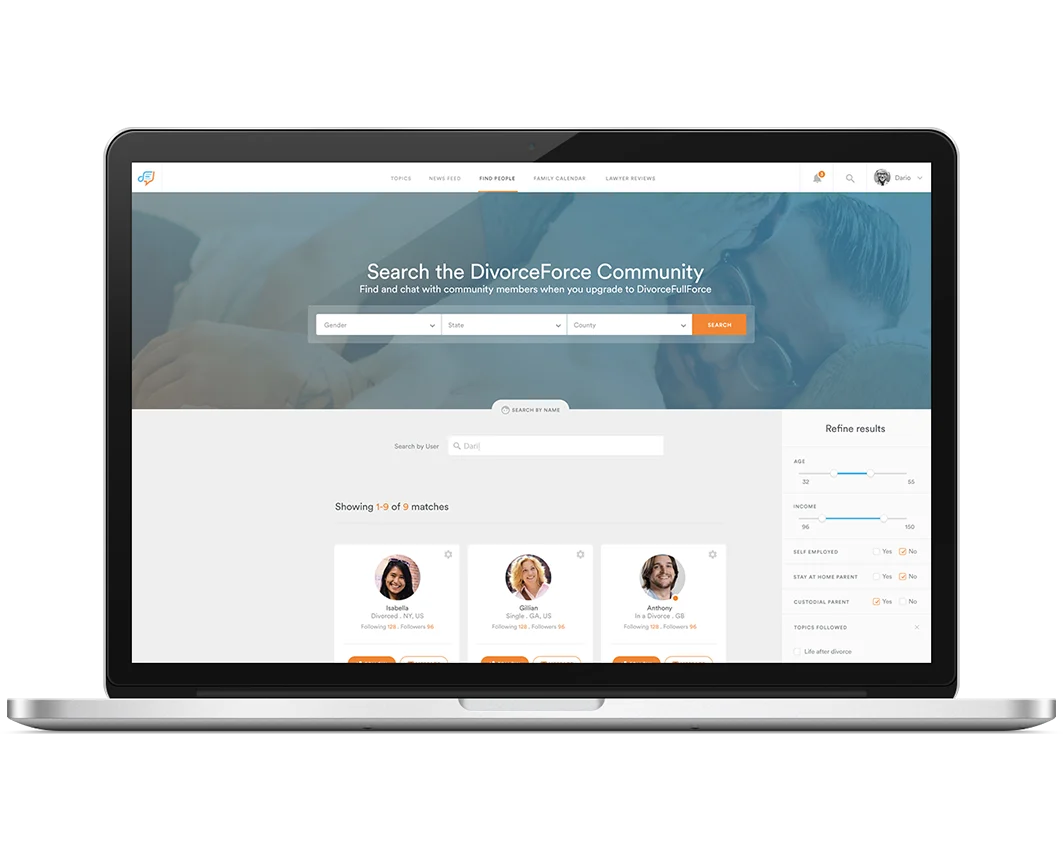
DivorceForce is a community for people going through divorce, a place to find relevant information and peers who understand. The founders chose us to design and engineer the first version of the product across responsive web, iOS and Android. We took it from high-level requirements to launch.
The challenge
Divorce pulls people into legal and personal workflows all at once, and the help they need is scattered. DivorceForce set out to bring that support into one place: news, discussion, advice on attorneys and practical tools for co-parenting.
The founders arrived with a clear mission and high-level requirements, not a finished specification. Part of our job was to turn that vision into concrete member journeys, then deliver them consistently on the web and on two native mobile platforms.
The product also mixed very different kinds of interaction. A public discussion thread, an attorney review and a shared custody calendar have nothing in common in terms of who should see them and how they should behave.
What we built
- Responsive web, iOS and Android apps, giving members the same community wherever they are.
- Member news feed and social feed to surface what is relevant to each person.
- Online forum for open discussion with people in similar situations.
- Chat for direct conversations between members.
- Attorney reviews so members can learn from each other's experience with lawyers.
- Shared custody calendar for the time-sensitive coordination that co-parenting demands.
We built the product with Ruby on Rails, AngularJS, iOS and Android.
Getting the boundaries right
Community software is more than a feed. Forum posts and attorney reviews are published content, with their own moderation needs. Chat and a shared custody calendar are private, and only the right people should ever see them. We designed each feature around who it is for, so members could share openly where they chose to and stay private where it mattered.
How the community fits together
How a DivorceForce member moves between public community features and private family tools.
Conceptual workflow
- Member account
- Community forum and feed
- Attorney reviews
- Shared calendar and chat
- Cross-platform user experience
Outcome
DivorceForce launched its first version across web, iOS and Android, and the product drew coverage from The Next Web, CNN and New York Business Journal.
How we'd build this today
How we'd build this today with Cortex
We built DivorceForce before Cortex existed. Starting it today, we'd begin with privacy, not pixels.
Our first move would be to write role, privacy and abuse-prevention rules as executable contracts, before generating a single screen. Cortex Pods would then build the member, review, calendar and messaging workflows against one shared permission model, with accessibility checks built in.
- Turn requirements into journeys. Convert the founders' high-level goals into member journeys with acceptance criteria.
- Design privacy fixtures. Model who may see messages, shared calendars and attorney reviews.
- Build to API contracts. Generate web and mobile components against versioned APIs.
- Test across devices. Confirm state and notifications behave the same on every platform.
- Check the hard cases. Moderation escalation, accessibility and member deletion requests.
Some decisions stay with people. Nobody can open another household's calendar without explicit permission, moderation and legal-risk calls stay under human policy, and no user-generated post is amplified without policy review. Our engineers approve the architecture, the privacy boundaries and the definition of done.
Frequently asked questions
What did we build for DivorceForce?
The first version of the product on responsive web, iOS and Android, with a member news feed, online discussions, chat, attorney reviews and a shared custody calendar.
Which technologies did we use?
Ruby on Rails, AngularJS, iOS and Android.
Was Cortex used on the original project?
No. DivorceForce launched well before Cortex; the five steps above are how we'd run a community build today.
Launching a community product?
We can take you from founder requirements to a first release on web and mobile. Explore our services or browse our work.