Case study
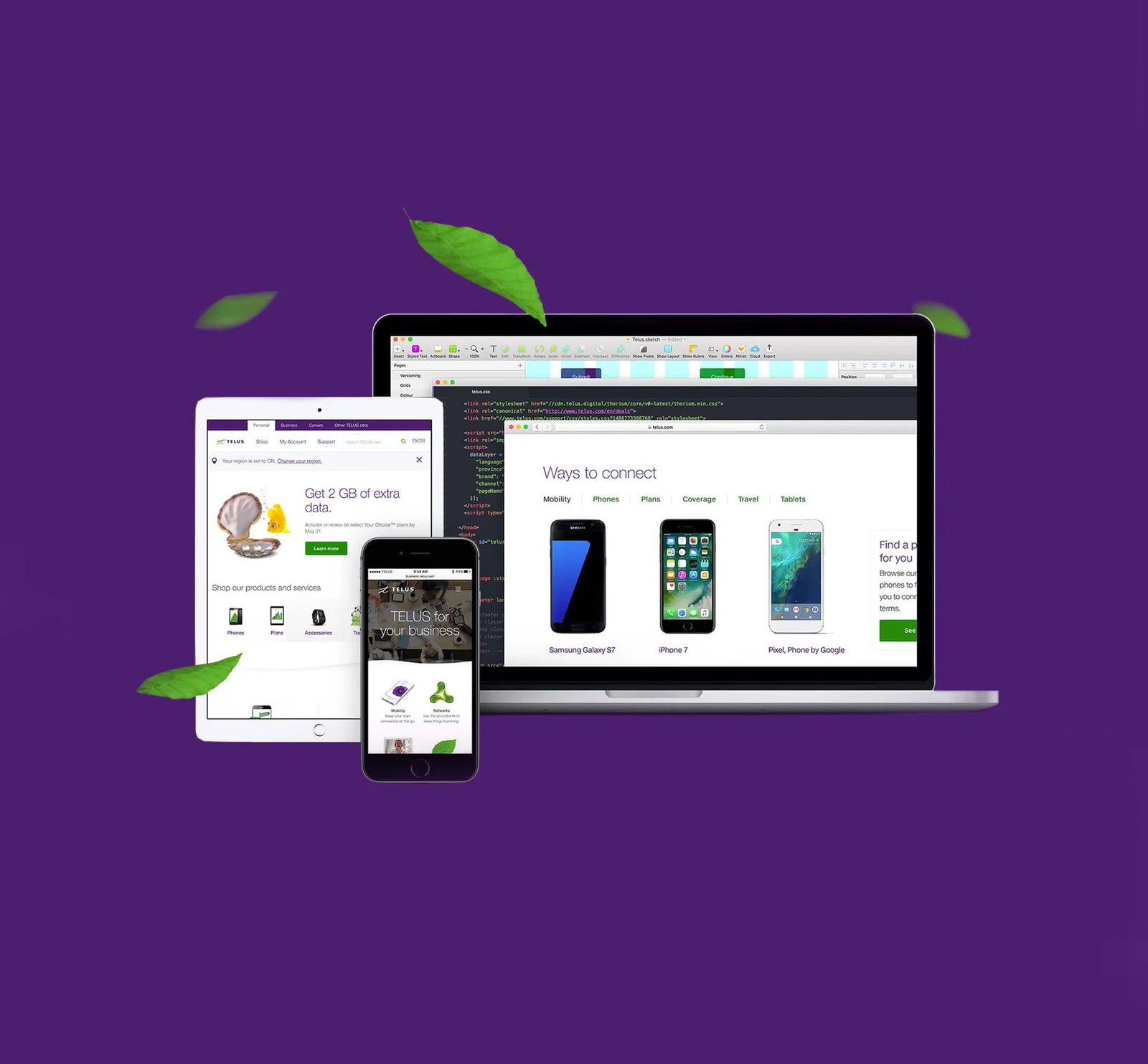
TELUS is one of Canada's major telecommunications companies. We worked with TELUS on a self-service app that brings all of a customer's telco services together in a single place, giving them a complete overview of their services and account details as part of a customer-first digital experience.
The app features a simple and intuitive layout. All telco services are laid out in a single app, offering users a complete overview of their account.
The challenge
Telecom customers rarely have just one thing. A household might have mobile lines, home internet and TV, each with its own plan, subscription status, invoices and support options. Traditionally, each of those lives in a different corner of the business, and the customer feels it.
The goal was the opposite: one simple, intuitive app where every service is visible at once. That simplicity on the surface depends on hard work underneath:
- Many service lines, one view. Each service has its own status and billing. The app has to present them side by side without confusing one with another.
- Trustworthy status. If the app shows a plan, a balance or a service state, the customer will act on it. What they see has to reflect the real state of the back-office systems.
- Clear actions. A complete overview is only useful if it makes the next step obvious: what you can change, pay or ask for, and where.
How we approached it
The product decision was to organize the experience around the customer, not around the telco's internal systems. One layout, all services, a complete picture.
For an app like this, the engineering effort sits in three places:
The experience
People need to understand at a glance what they have, what it costs and what they can do. A simple layout hides a lot of design decisions about what to show first and what to leave one tap away.
The data
Identity matching across services, validation and change history decide whether the overview is telling the truth. If two systems disagree about a customer's plan, the app needs a clear rule for which one wins.
Failure handling
Back-office systems time out and partial updates happen. A self-service app should show a clear, honest state when that occurs, never a false success.
How we'd build this today
How we'd build it today
Our TELUS work predates Cortex. For a unified telecom self-service app today, we would:
- Decide which system wins. For every account, bill and service, we would agree up front which back-office system has the final word, and test that the app follows it.
- Test the joins between systems. Automated tests would cover a customer matched across services, and what the app shows when two systems disagree about a plan.
- Generate accessibility and language tests. From the approved customer journeys, Cortex can produce test cases for screen readers and for each supported language.
- Keep AI help inside the customer's own data. If the app summarizes a bill or a support history, that summary only uses what the customer is allowed to see, with personal details masked.
Architects, domain owners and security reviewers each sign off on their part before a release goes to customers.
Frequently asked questions
What did we work on with TELUS?
A self-service app that lays out all of a customer's telco services in a single place, with a simple, intuitive layout and a complete overview of their account.
What makes unified telecom self-service hard?
Combining several service lines, billing records and support entitlements into one view that customers can trust and act on.
Was Cortex used on this project?
No. Our TELUS work came before Cortex.
Work with us
Bringing scattered services together into one customer view? We start with the systems behind the screen and what customers need to do next.