

Case study
Yatra is an established online travel business, but its mobile channel brought in only a sliver of revenue. We designed and built native iOS and Android apps for domestic and international flight and hotel search and booking. Within two months of launch, mobile's share of revenue rose from around 0.5% to over 16%.
The challenge
Before the apps, mobile contributed around 0.5% to 1.0% of Yatra's revenue. The answer wasn't to shrink the website onto a phone. Flight and hotel discovery, repeat booking and checkout had to feel native on every device, screen size and operating system, because travelers often search and book under time pressure and small frustrations cost bookings.
What we built
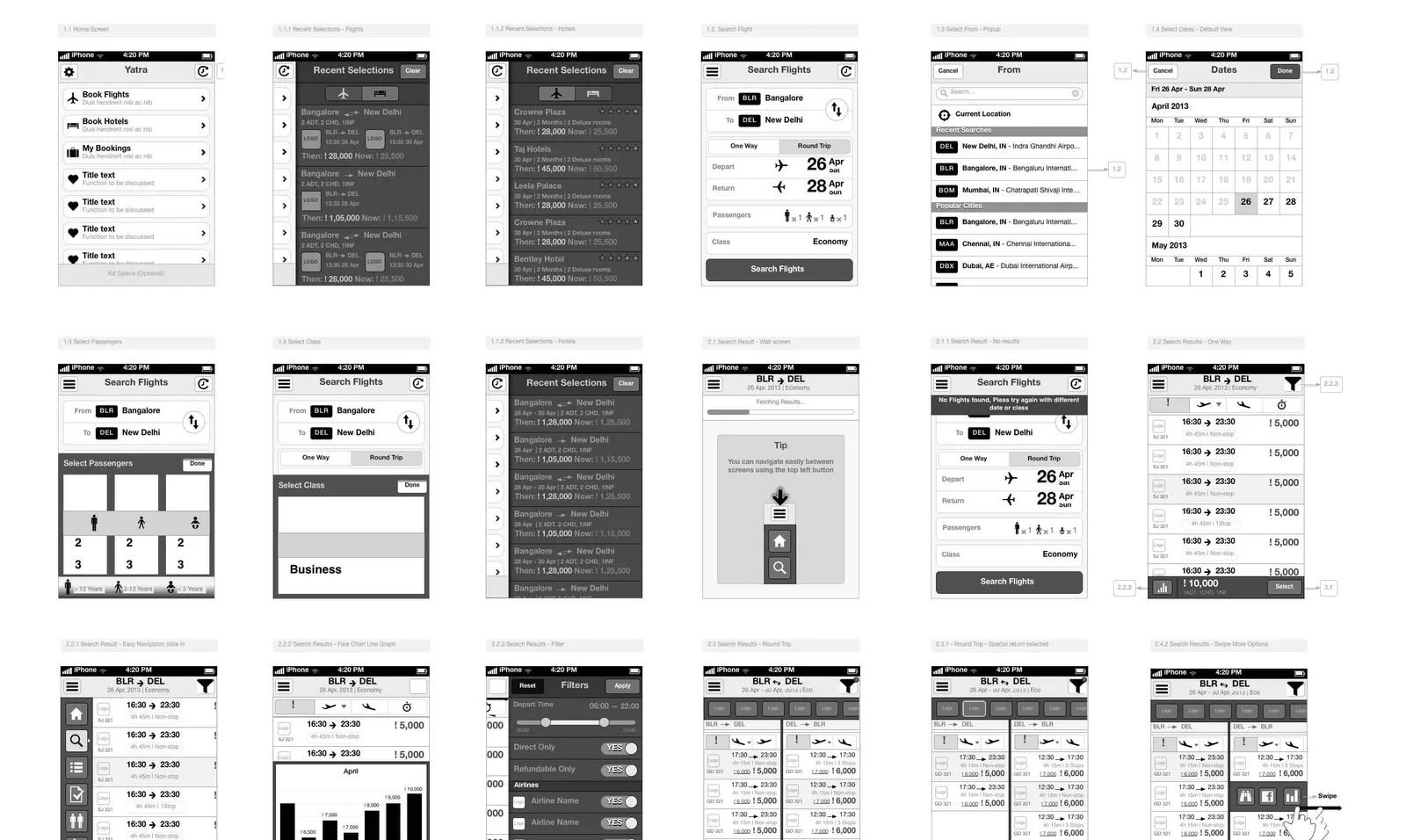
We designed and engineered native mobile experiences for iOS and Android, tailored UX by device, integrated Yatra's existing booking APIs, added customer and context caching, and ran automated testing and continuous integration throughout development. Along the way we created more than 500 wireframes and visual design assets.
Each platform designed as itself
Instead of identical screens everywhere, we designed separately for phones, tablets, Retina and non-Retina displays, and the range of Android devices. Small behaviors matter when someone is comparing flights or confirming a hotel on the move.
Mobile connected to the existing commerce system
Flight and hotel search, customer state, saved filters and booked travel all ran through Yatra's backend APIs. We customized those integrations to cut unnecessary round trips, and caching meant returning travelers picked up where they left off.
Booking and payment travelers can trust
The work included payment integration. Price, itinerary, availability and payment outcome had to be unmistakable before and after the traveler tapped to pay, and we built the booking flow around that.
Testing across a fragmented device landscape
With many screens and device-specific branches, defects could hide anywhere. Automated testing and behavior-driven development caught them during construction rather than after release.
How the workflow fits together
How a Yatra traveler moves from a flight or hotel search to a confirmed booking on mobile.
Conceptual workflow
- Traveler
- Native iOS / Android app
- Search & booking API
- Travel inventory
- Payment + booking confirmation
What changed
Mobile went from a footnote to a meaningful revenue channel: more than 16% of revenue within two months of launch. The apps also passed one million downloads.
What we took from it
Travel commerce is a chain of decisions: destination, dates, filters, price, passenger details and payment. Mobile creates commercial value when each of those steps gets easier without weakening the transaction.
How we'd build this today
How we would build this today with Cortex
We built Yatra's apps before Cortex existed. Starting the same project today, we would concentrate on the fare and payment moments where travel apps lose trust.
- Turn fare rules into tests. Route, date, currency and fare rules would be written as checks that run on every change, so the price on the search screen always matches checkout.
- Generate device tests from real journeys. Common traveler paths, such as a return flight with a hotel, would be replayed across a matrix of phones and tablets automatically.
- Use AI where the risk is low. Cortex can help modernize app state and SDK adapters; payments, availability and booking confirmation stay under strict, human-reviewed rules.
- Release on booking success. Each release would be judged on completed bookings, accessibility and speed, not just passing builds.
What the tests would check
- The fare shown matches the fare charged
- Retrying a payment never creates a duplicate booking or charge
- Saved filters and traveler details are stored only with the right privacy controls
- The confirmation screen always matches the reservation system
Frequently asked questions
What did CognitiveClouds build for Yatra?
Native iOS and Android apps for domestic and international flight and hotel search and booking, with device-tailored UX, customized API integration, caching, payment integration, CI and automated testing.
How much design work went into the apps?
More than 500 wireframes and visual design assets, with separate designs for phones, tablets and display types.
Was Cortex used on the original project?
No. Yatra's apps were built before Cortex; the Cortex section shows how we would approach them today.
Growing a mobile commerce channel?
If mobile should be pulling more weight in your business, we'd like to look at your booking or checkout journey with you.
See also: Mobile commerce work · Delivery approach · About us