
Case study
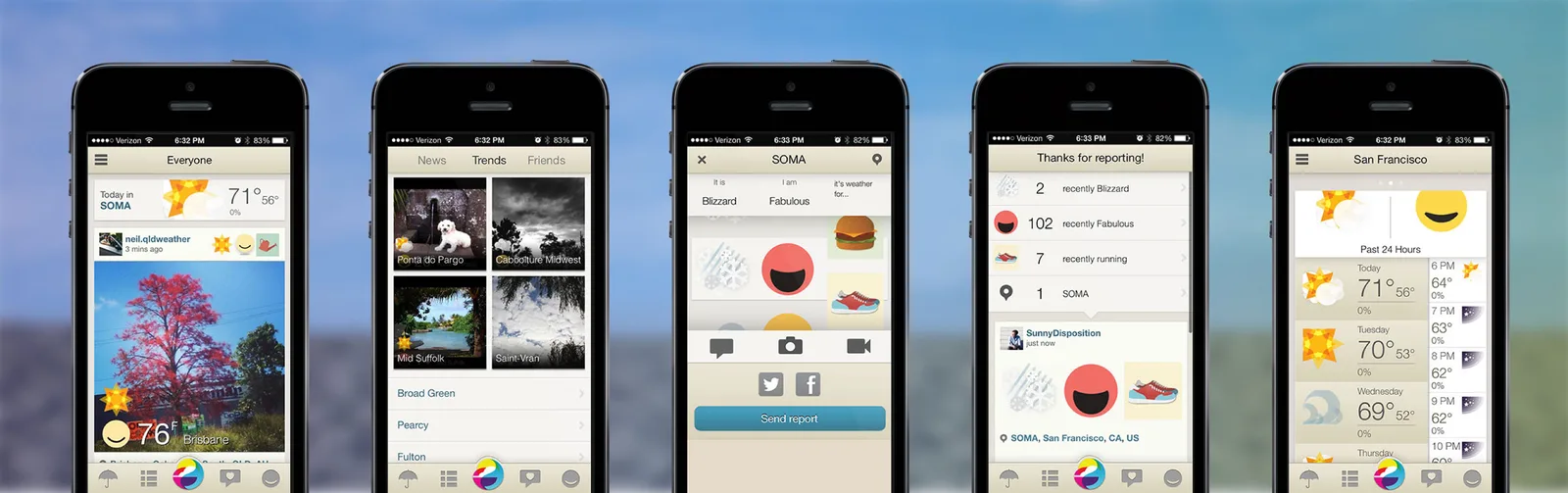
WeatherMob turned the weather into something people share. Its iPhone app let people share the weather where they were, discover reports from around the world and discuss them. We worked with WeatherMob on this social weather-reporting experience for iPhone. Yeti also contributed to the product.
Weathermob lets you share, discover, and discuss the weather with people from around the world. It’s a free, entertaining, and easy way to share your weather … on your iPhone.
The challenge
Weather apps usually broadcast a forecast. WeatherMob went the other way: the reports came from people. That makes the app feel alive, but it changes what matters. A report is only interesting if it's recent and from a real place, so time and location sit at the center of every post. Contributions come from users, not a data feed, and they need to feel personal without exposing more about someone than they meant to share.
The app also had to stay light. WeatherMob called itself free, entertaining and easy, so posting a report had to take seconds.
The product we worked on
Share
Posting a report is the heart of WeatherMob. A good share flow captures where and when a report was made, at a sensible level of location detail, and makes adding a quick description feel effortless.
Discover
Reports from around the world only mean something when people can see how recent they are and where they came from. Clear times and place names turn a stream of posts into a live picture of the weather.
Discuss
Conversation is what makes WeatherMob social rather than another weather tool. Discussion gives people a reason to come back, and it gives each report context beyond a single post.
Why trust matters in social weather
People need to know a report is recent, roughly where it came from and who shared it. They also need to feel safe sharing their own. For WeatherMob, that meant deciding early how precise a location should be and how long a report stays relevant, then carrying those decisions through the data and the design.
How we'd build this today
How we would approach it today with Cortex
WeatherMob came well before Cortex. If we were building a social weather app now, these are the things we would do from the first week.
- Give every report a clock and a place. Each post would carry its location permission, time and an expiry, so old weather drops out of the live view on its own.
- Simulate a stormy day. We would generate thousands of synthetic reports, including late, duplicate and misplaced ones, to see how the feed holds up when everyone posts at once.
- Test location privacy directly. Automated checks would confirm that a shared report never reveals a more precise location than the user chose.
- Keep people in charge of the sensitive calls. Cortex can draft and test the code, but our engineers and a security reviewer sign off on anything touching location or personal data.
What the tests would check
- A report older than its expiry no longer appears as current weather
- A user's location is never shown more precisely than they allowed
- Duplicate posts from a flaky connection appear once
- Discussion stays attached to the right report
Frequently asked questions
What is WeatherMob?
A free social weather-reporting app for iPhone that lets people share, discover and discuss the weather with others around the world.
Who else worked on WeatherMob?
Yeti also contributed to the product.
Was Cortex used on the original project?
No. WeatherMob was built long before Cortex; the section above is how we would approach it today.
Building a social or location-based app?
If your product depends on people sharing where they are and what they see, let's talk. We design for freshness, location and privacy from the first sprint.